Stop Guessing. Start Tracking. See Your Progress.
09/10/2026
Why recording your workouts is one of the most important things you can do to improve your fitness.
One of the things I regularly talk about at CrossFit Murrayfield is the importance of recording your workouts.
It's something that takes a couple of minutes after class, but it can make a massive difference to your training.
Think about it.
You turn up to the gym, do your workout, put in the effort, get a sweat on and head home.
Brilliant. You've done something positive for your health and fitness.
But here's my question.
How do you know you're actually getting better?
Are you lifting more weight than you were three months ago? Are you getting faster? Is your endurance improving? Are movements that used to be difficult becoming easier?
If you're not recording what you're doing, you're relying on memory.
And let's be honest, most of us can barely remember what we had for dinner last Tuesday, never mind what weight we deadlifted six weeks ago.
You Need to Know Where You Are Before You Can Work Out Where You're Going
This is probably the biggest point I want people to understand.
When someone joins CrossFit Murrayfield, one of the first things we do during their No Strings Intro is talk about their goals.
What do they want to achieve?
It might be losing body fat, getting stronger, improving fitness, building muscle or simply being able to keep up with their kids or grandkids.
But having a goal is only part of the process.
We need to know where you're starting from.
If your goal is to run a 5K without stopping, we need to know what you can currently manage.
If you want to deadlift 100kg, we need to know what you're lifting now.
If you want to improve your fitness, we need some way of measuring that improvement.
Otherwise, we're guessing.
And guessing isn't a particularly good way to plan someone's training.
Your Training Data Tells a Story
Every workout you record gives us another piece of information.
One workout on its own might not tell us very much.
But when we start collecting that information over weeks and months, patterns begin to appear.
We can see:
- Whether your strength is improving.
- Whether you're completing workouts faster.
- Whether you're managing heavier weights with good technique.
- Whether your endurance is getting better.
- Whether you've hit a plateau.
- Whether your training needs adjusting.
And here's something important.
Progress doesn't always mean lifting heavier or going faster.
Maybe six months ago you couldn't squat to full depth, but now you can.
Maybe you used to need to stop four times during a workout, but now you only stop once.
Maybe you're doing the same workout with better movement, more control and less recovery time.
That's progress.
And it's worth recording.
WodBoard: See Your Progress, Don't Just Guess It
At CrossFit Murrayfield, we use WodBoard to record our workouts and track progress.
But WodBoard does much more than just store your scores.
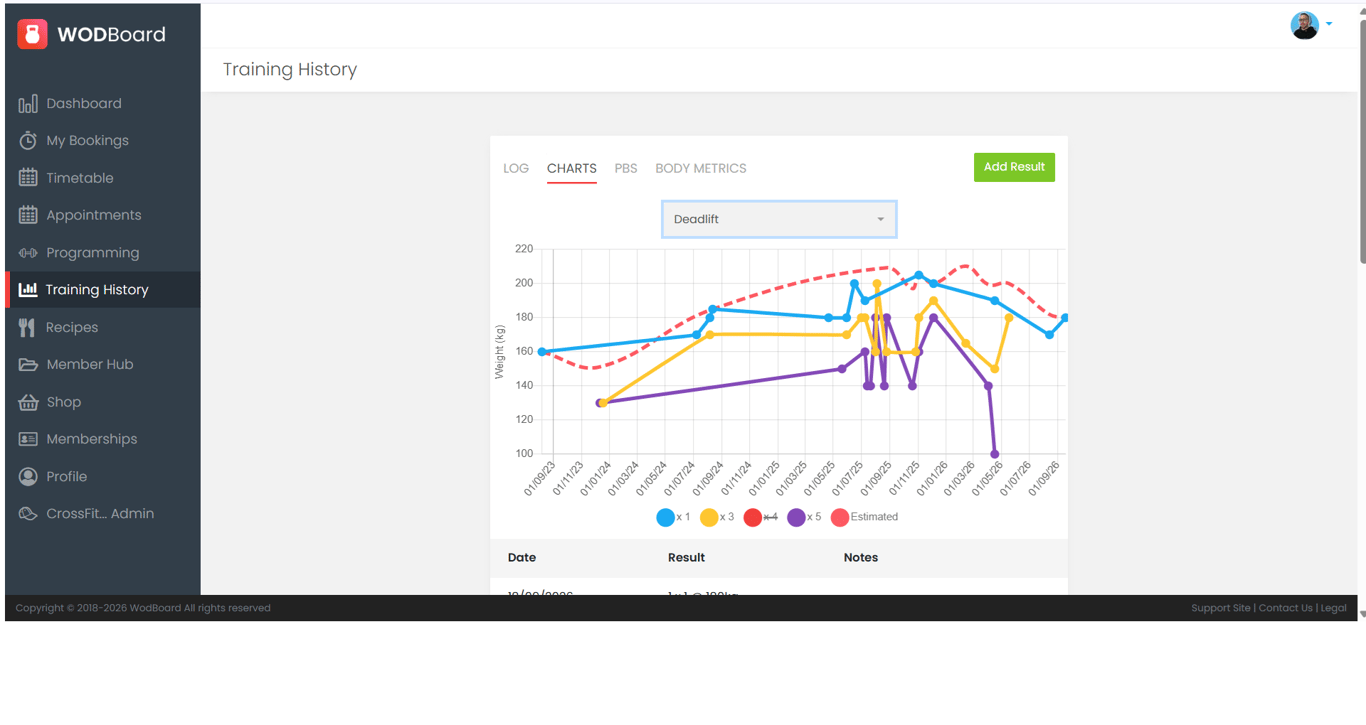
It has graphs that allow you to see how your performance changes over time, and it records your personal records, or PRs.
And this is where things get interesting.
Let's say you've been working on your back squat for the last six months.
You might not feel like you're getting much stronger because the improvements have been gradual.
But when you look at your graph and see that your squat has gone from 60kg to 80kg, there's your proof.
You've improved by 20kg.
The same applies to your rowing times, benchmark workouts and other recorded results.
Your PRs give you something to work towards, and the graphs help you see the bigger picture.
You might not notice the small improvements from week to week, but when you look back over six months, the difference can be massive.
And there's another benefit.
Motivation.
Sometimes people feel like they're not making progress because they're comparing themselves to someone else in the class.
But that's not what we should be focusing on.
We should be looking at where YOU started, where YOU are now and where YOU want to go next.
Your training is about your progress, not somebody else's.
Why Recording Workouts Helps Your Coaches
This is something people sometimes overlook.
Recording your workouts isn't just about you seeing your own progress.
It also helps us as coaches.
If we can see what you've been doing, we can make better decisions about what comes next.
We can identify areas where you're improving and areas that might need more attention.
We can look at your strength numbers, workout performances and consistency over time.
For example, if your deadlift is improving but your squat hasn't moved for several months, that's useful information.
It doesn't automatically tell us what's wrong, but it gives us somewhere to start looking.
Maybe it's technique, mobility, confidence, recovery or something else.
Without that information, we might never spot the pattern.
Good coaching isn't just about telling someone what to do today. It's about understanding what they've done before and helping them progress tomorrow.
Not Every Workout Needs to Be a Personal Best
I want to make this clear because it's important.
Recording your workouts doesn't mean you should be trying to beat your previous score every time you walk through the door.
That's not how good training works.
Some days you'll feel brilliant.
Other days you'll be tired, stressed, sore or just not firing on all cylinders.
And that's fine.
There are days when maintaining your performance is a good result.
There are days when scaling a workout is the sensible option.
There are also days when just turning up and moving is exactly what you need.
Recording those sessions still matters.
Because over time, we're not just looking at your best days. We're looking at the bigger picture.
And remember, if you're comparing workout times, weights or scores, you need to consider whether you used the same movements, standards and scaling options.
Otherwise, you might think you've improved when you've actually just done a different version of the workout.
That's why it's worth recording the details, not just the final score.
Consistency Is Just as Important as Performance
Another thing your training records can show is consistency.
And consistency is one of the biggest factors in making progress.
You don't need to be the strongest or fastest person in the gym.
You need to keep turning up, putting in the work and building on what you've already achieved.
If you train three times a week, that's potentially over 150 training sessions in a year.
Imagine having a record of all those sessions.
The weights you've lifted.
The workouts you've completed.
The personal records you've achieved.
The improvements you've made.
That's a lot of useful information.
And when you put it all together, you can see just how far you've come.
We Can Also Use That Information to Set Better Goals
At CrossFit Murrayfield, we're big believers in setting goals and reviewing progress.
But a goal needs to be realistic, measurable and based on where you currently are.
There's no point in me telling someone they should be lifting a certain weight without understanding their current ability.
That's where your training history becomes valuable.
If we know your current strength numbers, workout times and performance trends, we can start setting sensible targets.
We can work out what needs improving and put a plan in place to help you get there.
Then, when we review your progress, we're not relying on how you think things have gone.
We've got actual results to look at.
And if something isn't working, we can make changes.
That's the difference between simply exercising and training with a purpose.
So Here's My Challenge to You
The next time you finish a workout at CrossFit Murrayfield, take a couple of minutes to record it on WodBoard.
Put in your score.
Record the weight you lifted.
Make a note of any scaling you used.
And if there's something worth remembering about the session, add that too.
Then take a look back at your previous results.
Check your graphs.
Look at your PRs.
See how far you've come.
You might be surprised by what you find.
And if you're not sure what the information is telling you, speak to one of the coaches.
That's what we're here for.
Final Thoughts
Fitness isn't just about turning up, getting sweaty and going home.
It's about improving your health, building strength, developing confidence and being able to do more than you could before.
But to understand that progress, we need to measure it.
We need to know where we started.
We need to know where we are now.
And we need to know where we want to go.
Because if we're not recording what we're doing, how can we plan where we're going?
So stop guessing. Start tracking. And give yourself the chance to see just how much you're improving.
CrossFit Murrayfield
Fun. Fair. Friendly. Family. Fitness.
Ready to Start Your Own Fitness Journey?
Whether you're completely new to CrossFit or looking to take your training further, we're here to help.
At CrossFit Murrayfield, we don't just put you through workouts. We help you understand your fitness, set realistic goals and work towards them.
Your first step is our No Strings Intro, where we'll sit down, discuss your goals and work out the best way forward.